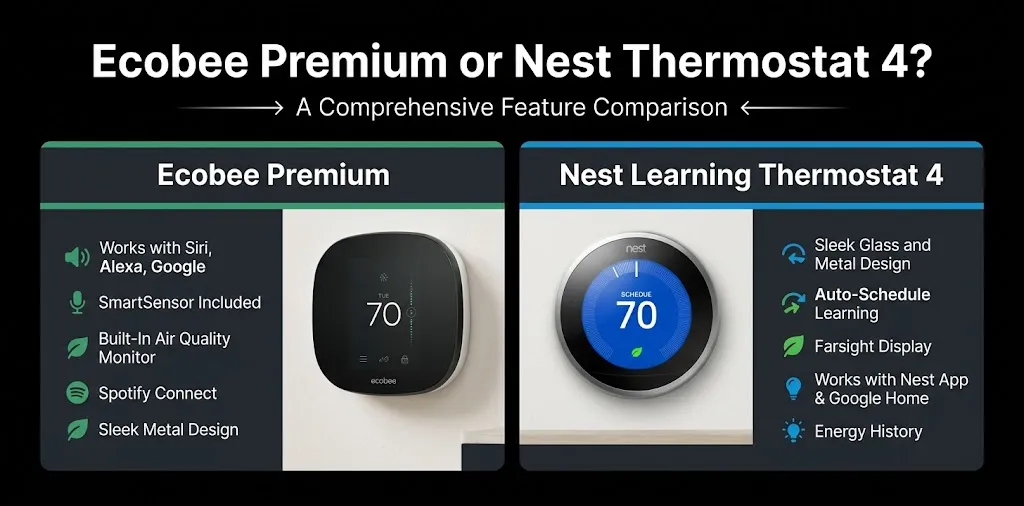
Ecobee Premium or Nest Therm ostat 4?For multi-zone?

Choosing between the Ecobee Smart Thermostat Premium and Google Nest Learning Thermostat (4th gen) becomes more complicated when your home has multiple heating and cooling zones. Both offer smart temperature control, but the key question is whether you need to manage separate HVAC zones or simply balance temperatures across different rooms.
A smart thermostat can improve comfort and help manage energy use, but it cannot automatically turn a single-zone HVAC system into a true multi-zone system. Your existing equipment, zone controls, and wiring matter just as much as the thermostat itself.
Ecobee Premium vs. Nest Thermostat 4: Key Differences
The Ecobee Smart Thermostat Premium and Google Nest Learning Thermostat (4th gen) can both work with compatible zoned HVAC systems. However, they take different approaches to room comfort, automation, and smart-home control. Ecobee stands out for its room sensors and broad smart-home integration, while Nest focuses on automatic scheduling and a polished user experience.
| Feature | Ecobee Smart Thermostat Premium | Google Nest Learning Thermostat (4th gen) |
|---|---|---|
| Multi-zone compatibility | Works with compatible zone control boards | Supports compatible zoned HVAC systems |
| Included room sensor | SmartSensor with temperature and occupancy detection | Nest Temperature Sensor (2nd gen) |
| Additional room sensors | Supports up to 32 compatible Room Sensors | Supports compatible Nest Temperature Sensors |
| Temperature scheduling | Custom schedules and occupancy-based comfort settings | Learns routines and adjusts schedules automatically |
| Smart-home integration | Apple HomeKit, Alexa, Google Home, and other supported integrations | Google Home and Matter-compatible ecosystems |
| Built-in voice assistant | Alexa built in; Siri support with a compatible HomePod | No built-in voice assistant |
| Air-quality features | Built-in indoor air-quality monitoring | No equivalent built-in VOC air-quality monitor |
| Power requirements | C-wire or included Power Extender Kit, where supported | Designed to work without a C-wire in most compatible installations |
| Best fit | Sensor-based comfort and flexible smart-home control | Automatic scheduling and Google Home users |
| Available |  | |
Compatibility and features depend on the HVAC equipment, wiring, accessories, and supported smart-home setup.
What Does Multi-Zone Mean for a Smart Thermostat?
Before choosing either thermostat, it helps to understand two different ways people use the term multi-zone.
True multi-zone HVAC control
A true multi-zone system divides your home into separate heating or cooling areas. Each zone can call for heating or cooling based on its own thermostat and temperature settings. A zone control panel, dampers, and compatible HVAC equipment coordinate how conditioned air reaches each area.
For example, a two-story home might have one zone for the first floor and another for the second floor. If the upstairs gets warm at night, its thermostat can request cooling without requiring the downstairs to use the same temperature setting.
Both Ecobee and Nest can work with certain zoned systems. However, compatibility depends on the zone control panel and the way the system is wired.
Room sensors for balancing comfort
Room sensors solve a different problem. They measure conditions in individual rooms and help a thermostat make decisions based on those readings. They do not independently operate dampers or create separate HVAC zones.
Imagine a home with one thermostat downstairs and bedrooms upstairs that regularly feel warmer. Adding sensors to those bedrooms can help the thermostat account for temperatures away from its wall-mounted location. But if the home has only one HVAC zone, the system still generally heats or cools the home as one zone.
This distinction matters because buying additional sensors is not the same as installing a multi-zone HVAC system.
Which Thermostat Handles Multiple Zones Better?
Ecobee Premium: Better for sensor-based comfort
Ecobee Premium is particularly useful when different rooms feel uncomfortable even though the main thermostat reports the desired temperature.
Its included SmartSensor measures temperature and occupancy. You can add compatible sensors in bedrooms, living areas, or other rooms and configure which sensors influence comfort settings. Ecobee supports up to 32 compatible Room Sensors, giving it flexibility for larger homes.
This is helpful in situations such as:
- Warm upstairs bedrooms: Give the thermostat more information about temperatures in the rooms where your family sleeps.
- An underused guest room: Use occupancy-aware comfort settings to help avoid prioritizing an empty room.
- A large open-plan home: Use multiple sensors to make temperature decisions less dependent on the thermostat’s immediate surroundings.
Ecobee also works with compatible HVAC zone control boards, so it can be a good choice for an existing multi-zone setup. You must still confirm that your specific zone panel supports the intended installation.
One limitation is that room sensors cannot overcome every airflow problem. If one room has blocked vents, poor insulation, or inadequate ductwork, a sensor alone will not fix the underlying cause.
Nest Learning Thermostat (4th gen): Better for automatic scheduling
The fourth-generation Nest Learning Thermostat suits homeowners who want their heating and cooling schedules to adapt to their routines. It learns from temperature adjustments and supports automatic scheduling, while the included Nest Temperature Sensor lets you account for conditions in another room.
Nest may be a good fit if you want to:
- Adjust the temperature based on your usual daily routine.
- Monitor a bedroom or other room away from the thermostat.
- Use Google Home as the main place to control your smart devices.
- Choose a thermostat with a distinctive display and simple physical controls.
Nest also supports compatible zoned HVAC systems, including some systems that use dampers. However, sensor readings do not independently control each zone’s dampers. The system’s thermostat and zone-control arrangement must support that function.
Another point to consider is that Nest’s temperature sensor and Ecobee’s SmartSensor are not identical. Ecobee sensors include occupancy detection, while Nest’s temperature sensors are primarily intended to report temperature for supported comfort and scheduling features.
Installation and Compatibility: The Most Important Checks
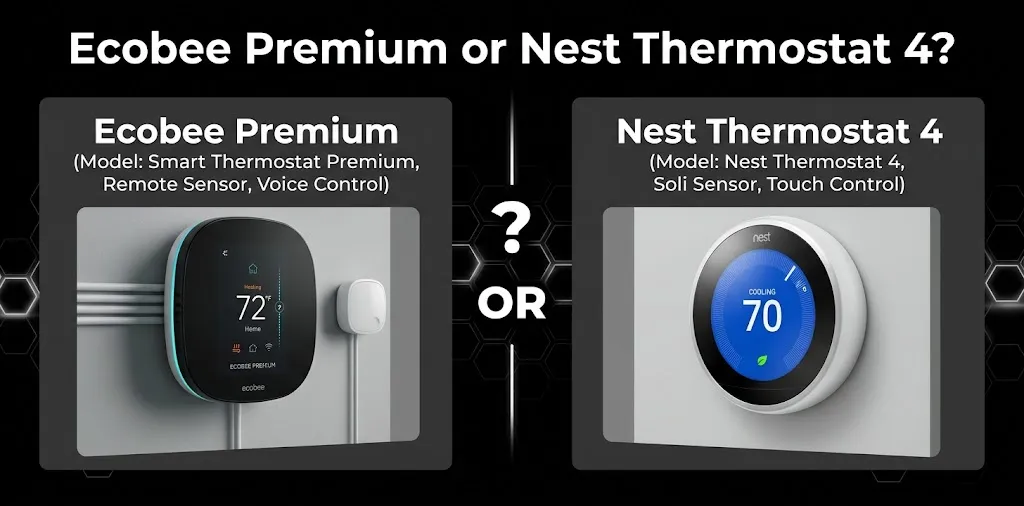
Multi-zone systems require more care than a typical thermostat replacement. Before purchasing either model, check these points.
1. Identify your existing zone-control setup
Find out whether your home has separate thermostats for each zone, a central zone control panel, or a system with multiple independent HVAC units.
If your home has two independent systems, for example, you may be able to use a separate compatible thermostat for each system. If it has one HVAC unit and motorized dampers, the thermostats must work correctly with the existing zone panel.
Do not assume that a thermostat supporting multiple heating and cooling stages automatically supports every multi-zone configuration.
2. Check wiring and power requirements
Ecobee Premium includes a Power Extender Kit for certain installations without a C-wire. Nest Learning Thermostat (4th gen) is designed to operate without a C-wire in most compatible installations, although some systems still require one or a Nest Power Connector.
Zone control panels can have specific power requirements, so check compatibility with the exact panel model rather than relying only on the thermostat manufacturer’s general compatibility checker.
3. Confirm how many thermostats you need
If you already have three independently controlled HVAC zones, you may need a compatible thermostat for each zone. One smart thermostat with several room sensors generally cannot replace three independent zone thermostats.
Ask an HVAC professional to confirm whether your current zone board supports the thermostat you want, particularly if the system uses proprietary controls or has unusual wiring.
Two Realistic Examples: Which One Makes More Sense?
Example 1: A two-story home with uneven temperatures
Imagine a home where the downstairs living room stays comfortable, but the upstairs bedrooms become too warm at night.
If both floors belong to a single HVAC zone, Ecobee Premium is an attractive choice because its SmartSensor can help the thermostat account for bedroom temperatures and occupancy. Nest can also use a remote temperature sensor, so it remains a reasonable alternative for a homeowner who prefers automatic scheduling.
However, neither thermostat’s room sensor will independently cool the upstairs while leaving the downstairs untouched. That requires suitable zone controls or another HVAC solution.
Example 2: A home with three existing HVAC zones
Now imagine a home with three zones, each managed by a central control panel and its own thermostat.
In this case, the first priority is ensuring that each replacement thermostat works with the zone panel. Ecobee Premium may appeal to a homeowner who wants occupancy-aware sensors and flexible smart-home integration. Nest may appeal to someone who prefers its automatic learning and Google Home controls.
The winner depends on compatibility first and convenience second. A thermostat with more features is not a better choice if it cannot communicate properly with your existing HVAC controls.
Price and Overall Value
Both models sit in the premium smart thermostat category. The Google Nest Learning Thermostat (4th gen) launched at a higher list price than the Ecobee Premium, although current retailer prices and promotions can change the difference.
When comparing total costs, account for more than the thermostat itself:
- Extra sensors: Check whether you need more sensors for bedrooms or other areas.
- Additional thermostats: Each independently controlled zone may need its own thermostat.
- Installation: Wiring changes or zone-panel adjustments may require professional work.
- System repairs: Poor airflow, faulty dampers, or insulation problems may need separate attention.
If both thermostats are compatible with your setup and priced similarly, Ecobee Premium offers strong value for households that will use its room sensors and smart-home features. Nest is worth considering if you prefer its learning features and Google Home experience.
Neither thermostat guarantees lower energy bills. Actual savings depend on your equipment, climate, insulation, temperature settings, and how you use the system.
Frequently Asked Questions
Here are some common questions about the Ecobee Smart Thermostat Premium and Google Nest Learning Thermostat (4th gen) to help you understand their multi-zone compatibility, room sensor features, and which model may work best with your home’s heating and cooling system.
Is Ecobee Premium better than Nest Thermostat 4 for multiple zones?
Ecobee Premium is often the better fit for sensor-based comfort because its SmartSensors detect both temperature and occupancy. Nest Learning Thermostat (4th gen) is a strong alternative for automatic scheduling and Google Home users. For true multi-zone control, compatibility with your zone panel matters more than either thermostat’s extra features.
Can I use Ecobee Premium or Nest Thermostat 4 with two HVAC zones?
Yes, both can work with certain two-zone HVAC systems, including compatible systems with zone dampers. However, the installation may require a thermostat for each zone and must follow the zone panel’s wiring and control requirements.
Do room sensors create separate heating and cooling zones?
No. Room sensors measure conditions in different rooms and help a compatible thermostat make better temperature decisions. Independent zone control requires compatible HVAC equipment, zone controls, and the appropriate thermostat arrangement.
Final Verdict
For most homeowners who want better room-by-room comfort, Ecobee Smart Thermostat Premium is my preferred choice, thanks to its occupancy-aware SmartSensors and flexible smart-home integration. Nest Learning Thermostat (4th gen) is a better match for people who prioritize automatic scheduling, a distinctive design, and Google Home.
If your main goal is managing multiple HVAC zones, check your existing zone-control panel before choosing either model. Practical tip: Take a photo of your current thermostat’s wiring and note the zone panel’s model number, then confirm compatibility with the manufacturer or a qualified HVAC technician before buying.