Anker Zolo or Baseus Adaman? For long trips?

Choosing between the Anker Zolo and Baseus Adaman for long trips comes down to battery capacity, charging speed, portability, and how often you need to recharge your devices. Both product lines include different models, so the best choice depends on the exact version you buy. For travel, reliable capacity and convenient charging matter more than a single advertised wattage.
Anker Zolo vs. Baseus Adaman: Main Differences
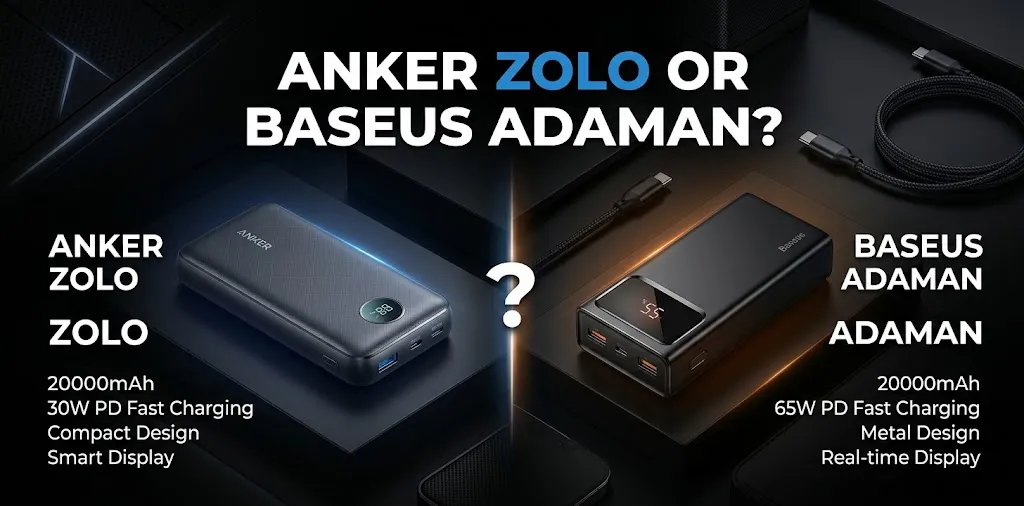
This comparison focuses on the Anker Zolo 20,000mAh 30W model with built-in USB-C and Lightning cables and the Baseus Adaman 20,000mAh 65W model. Both offer substantial battery capacity, but the Baseus provides more charging power for compatible laptops, while the Anker focuses on convenient phone charging.
| Feature | Anker Zolo 20K 30W | Baseus Adaman 20K 65W |
|---|---|---|
| Battery capacity | 20,000mAh | 20,000mAh |
| Maximum USB-C output | 30W | 65W |
| Built-in cables | USB-C and Lightning | No built-in charging cable |
| Display | Model-dependent | Digital display |
| Laptop charging | Suitable for compatible lower-power needs | Better for compatible USB-C laptops |
| Phone charging | Up to 30W, depending on device | Up to 65W, depending on device |
| Best use | Convenient phone and tablet charging | Higher-power travel charging |
| Available |  | |
Actual charging speeds depend on the device, cable, charging protocol, and whether other devices are connected. Maximum output does not mean every device will charge at that speed.
Which Power Bank Is Better for Long Trips?
For trips involving several devices, the Baseus Adaman 65W is the stronger choice if you need to charge a compatible laptop as well as your phone. Its higher USB-C output and digital display make it useful when you need more power and want to check the remaining battery level.
The Anker Zolo is more convenient if your main goal is keeping your phone charged throughout a day of travel. Its built-in USB-C and Lightning cables mean you can leave separate charging cables at home, provided the integrated cables match your devices.
Choose Anker Zolo if convenience matters most
Anker Zolo is a practical option for travelers who mainly use a smartphone, wireless earbuds, and other small devices.
Its main advantages include:
- Built-in cables that reduce the number of accessories you need to pack.
- 20,000mAh capacity for multiple phone recharges.
- Up to 30W USB-C charging on the model compared here.
- Support for charging multiple devices through its available cables and ports.
For example, if you’re taking a long bus ride and want to charge your phone while keeping your bag organized, the built-in cables can be more useful than extra charging power you may never need.
Choose Baseus Adaman if you need more charging power
The Baseus Adaman 65W is better suited to travelers carrying power-hungry devices. Its USB-C output can support compatible laptops, tablets, and smartphones, while its digital display shows battery percentage and charging information.
Consider a hypothetical three-day trip where you need to keep a phone, tablet, and compatible USB-C laptop running. The Adaman gives you more flexibility for the laptop, although charging several devices at once can reduce the power available to each one.
Its main trade-offs are the need to carry a suitable cable and its relatively substantial weight. The 20,000mAh model weighs approximately 447 grams.
Is 20,000mAh Enough for a Long Trip?
For many travelers, yes. A 20,000mAh power bank can provide several smartphone recharges, depending on the phone’s battery size, charging losses, and how much power you use during the trip.
However, the advertised capacity is based on the power bank’s internal battery cells. You won’t get the full 20,000mAh delivered directly to your phone because voltage conversion and heat cause energy losses.
Think about your travel plans:
- One-day trip: Either model may offer more capacity than you need, depending on your phone usage.
- Two- or three-day trip: A 20,000mAh power bank can be useful if you won’t have regular access to wall outlets.
- Long trip with a laptop: The Baseus Adaman 65W makes more sense if your laptop supports USB-C charging at a compatible power level.
- Several devices and limited packing space: The Anker Zolo’s built-in cables can help reduce clutter.
Neither power bank can guarantee a fixed number of recharges for every phone or laptop. Screen use, navigation, video streaming, and mobile data can all affect how quickly your devices consume power.
What About Air Travel?
Both models have a nominal battery capacity of 20,000mAh, equivalent to approximately 74Wh for the versions discussed here. That is below the commonly used 100Wh threshold for lithium-ion power banks on passenger flights, but you should still check your airline’s current requirements.
Keep these points in mind before flying:
- Carry power banks in your cabin baggage rather than placing them in checked luggage, subject to your airline’s rules.
- Protect the power bank from accidental short circuits and physical damage.
- Check whether your airline restricts the use or charging of power banks during the flight.
- Make sure the battery capacity marking is readable on the device.
Airline policies can differ, so do not rely on battery capacity alone as proof that a power bank is permitted.
Which One Offers Better Value?
Value depends on the price of the exact model and what you plan to charge. The Anker Zolo may offer better everyday value if you mainly charge phones and appreciate its built-in cables. The Baseus Adaman may justify its cost if you need 65W output for a compatible laptop or another device that benefits from higher charging power.
Before buying, compare the exact model number, local warranty, included cable, and price. The names Zolo and Adaman cover multiple models, so make sure you’re comparing the 20,000mAh versions discussed here rather than a smaller-capacity variant.
Frequently Asked Questions
Here are some common questions about the Anker Zolo and Baseus Adaman power banks to help you choose the right option for long trips. From charging speed and battery capacity to portability and laptop compatibility, these answers cover the key factors to consider before buying.
Is Anker Zolo or Baseus Adaman better for a three-day trip?
The Baseus Adaman 65W is the better choice if your trip includes a compatible laptop, tablet, and phone. If you mainly need phone charging and want fewer cables in your bag, the Anker Zolo is a convenient alternative.
Can the Baseus Adaman charge a laptop faster than Anker Zolo?
It can charge compatible USB-C laptops at higher power because the Adaman model supports up to 65W, compared with 30W for the Anker Zolo model discussed here. Actual charging speed depends on your laptop’s requirements and the cable you use.
Which power bank is easier to carry while traveling?
The Anker Zolo is convenient because its built-in cables reduce the number of accessories you need to carry. The Baseus Adaman offers more output power but weighs about 447 grams, so check its dimensions and weight against your packing needs.
Final Verdict
Winner for long trips: Baseus Adaman 20,000mAh 65W. It offers greater charging flexibility for travelers who carry a compatible laptop alongside their phone and other devices.
Choose the Anker Zolo 20,000mAh 30W instead if you mainly charge smartphones and prefer built-in cables over higher output power.
One expert tip: check the maximum USB-C charging wattage supported by your most power-hungry device before buying. That single detail can help you choose a power bank that meets your needs without paying for power you won’t use.