
Anker Solix or Jackery 1000 Pro? For camping?

Choosing between Anker SOLIX and the Jackery Explorer 1000 Pro for camping depends on the exact Anker model, how much power you need, and how long you plan to stay outdoors. The Jackery Explorer 1000 Pro is a portable power station designed for off-grid use, while Anker SOLIX offers several models with different capacities and features. For camping, battery capacity, weight, charging speed, and solar compatibility matter most.
Anker SOLIX C1000 vs. Jackery Explorer 1000 Pro: Key Differences
For this comparison, Anker SOLIX means the original C1000, not the newer C1000 Gen 2 or larger SOLIX models. The C1000 offers more AC output and faster recharging, while the Jackery Explorer 1000 Pro has a slightly smaller battery and weighs less.
| Feature | Anker SOLIX C1000 | Jackery Explorer 1000 Pro |
|---|---|---|
| Battery capacity | 1,056Wh | 1,002Wh |
| Battery chemistry | LiFePO4 | Lithium-ion NMC |
| Continuous AC output | 1,800W | 1,000W |
| Maximum solar input | 600W | Up to 800W |
| AC recharge time | As fast as 58 minutes | About 1.8 hours |
| Weight | About 28.4 lb | About 25.4 lb |
| Best use | Higher-power camping gear | Lighter camping power setup |
| Available |  | |
Actual charging times depend on the charging mode, conditions, and equipment. Maximum solar input is not a guarantee of real-world charging speed.
Which Power Station Is Better for Camping?
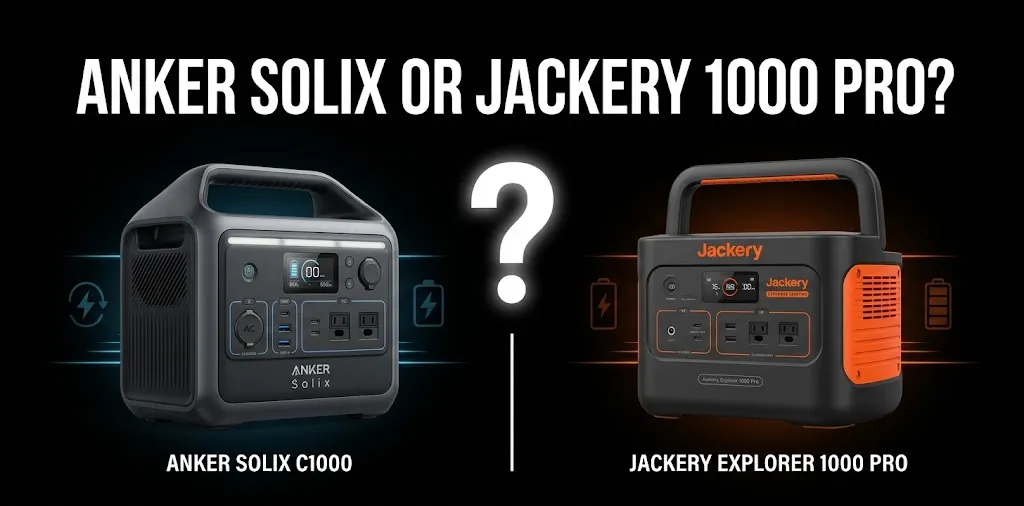
Choose Anker SOLIX C1000 for Higher-Power Equipment
The Anker SOLIX C1000 is the stronger choice if your camping setup includes several devices or equipment that draws more power. Its 1,800W continuous AC output gives you more flexibility than the Jackery Explorer 1000 Pro’s 1,000W rating.
It also uses a LiFePO4 battery, which is designed to handle more charge cycles than the NMC battery in the original Jackery 1000 Pro. The C1000 has a capacity of 1,056Wh and supports solar charging at up to 600W.
The Anker is worth considering if you:
- Camp for multiple nights and recharge the station regularly.
- Need to power higher-wattage equipment within its rated limits.
- Want faster charging from a suitable wall outlet before leaving home.
- Plan to use compatible solar panels at your campsite.
The main trade-off is weight. At around 28.4 pounds, the C1000 is better suited to car camping than trips where you must carry all your gear over long distances.
Choose Jackery Explorer 1000 Pro for a Lighter Setup
The Jackery Explorer 1000 Pro weighs about 25.4 pounds, making it roughly 3 pounds lighter than the original Anker SOLIX C1000. That difference can matter when you are moving equipment between your vehicle, campsite, and picnic area.
Its 1,002Wh capacity is close to the Anker’s, so you should not expect a major difference in stored energy alone. However, its 1,000W continuous AC output means you need to pay closer attention to the power requirements of your appliances.
The Jackery may suit you better if you:
- Want a portable power station for weekend car camping.
- Mainly charge phones, cameras, tablets, lights, and similar electronics.
- Already own compatible Jackery SolarSaga panels.
- Find it at a better price than the Anker.
One important point: the Explorer 1000 Pro is an older model than some newer Jackery 1000-series stations. Compare its actual price and warranty with newer options before buying.
How Long Will Each Power Station Last at a Campsite?
Both stations store roughly 1kWh of energy, but actual runtime depends on what you plug in, how much power it draws, and energy lost during conversion.
A useful estimate is:
Estimated runtime (hours) = usable battery energy (Wh) ÷ device power (W)
For example, if you have around 900Wh available for your devices after allowing for conversion losses and a reserve:
| Camping equipment | Approximate power draw | Estimated runtime |
|---|---|---|
| LED camping lights | 10W | 90 hours |
| Phone charging | 10W average | 90 hours of equivalent use |
| Laptop | 60W | 15 hours |
| Portable cooler | 50W average | 18 hours |
| Electric cooking appliance | 1,000W | 54 minutes |
These are illustrative estimates, not guaranteed results. A refrigerator or cooler cycles on and off, and phone charging is intermittent, so their actual usage patterns differ. Electric cooking appliances can also consume a large share of your battery in a short time.
For a two-night camping trip with phones, lights, and occasional laptop use, either station may be sufficient. If you want to run a high-power appliance, check its wattage and startup requirements before choosing a model.
Solar Charging and Off-Grid Camping
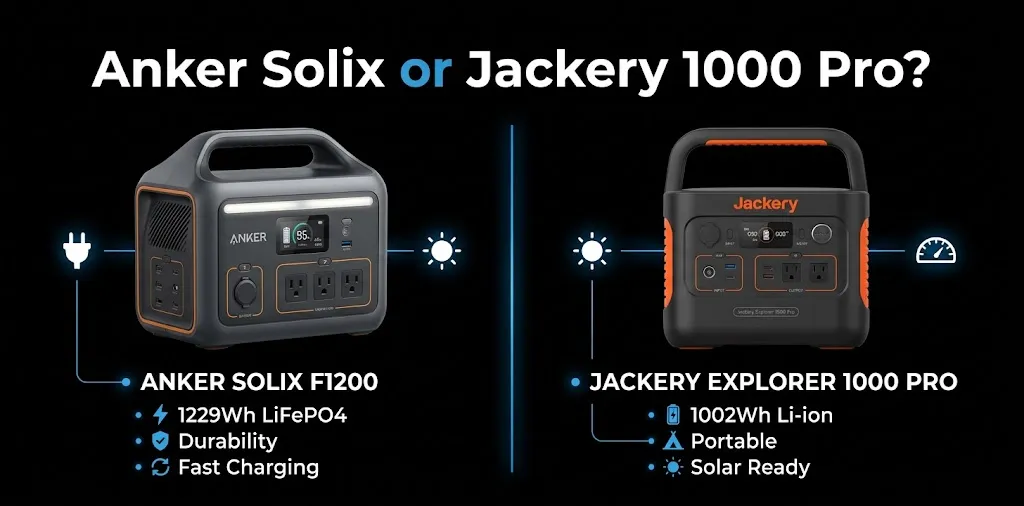
Solar charging can help you stay at a campsite longer without returning to an electrical outlet. However, the maximum solar input rating does not tell you how quickly a station will recharge under real outdoor conditions.
The Anker SOLIX C1000 accepts up to 600W of solar input, while the Jackery Explorer 1000 Pro supports up to 800W under its specified input configuration. Actual energy collection varies with sunlight, shade, panel angle, temperature, and compatible equipment.
Before purchasing solar panels, check three things:
- Connector compatibility: Make sure the panel cables and adapters match the power station’s solar input.
- Voltage limits: The combined panel voltage must remain within the station’s supported range.
- Available sunlight: Trees, clouds, and partial shade can reduce charging considerably.
For example, a camper spending a weekend beneath dense tree cover should not count on solar panels to replace all the energy used each day. A sunny, open campsite offers better charging conditions.
Which Is the Better Value?
The better deal depends on the current selling price, included accessories, warranty terms, and whether you already own compatible solar panels.
The Anker SOLIX C1000 offers higher AC output, a LiFePO4 battery, and rapid AC charging. The Jackery Explorer 1000 Pro is lighter and may make sense if it is available at a substantial discount.
Also, compare battery lifespan rather than looking only at the initial purchase price. Anker uses LiFePO4 chemistry for the C1000, while the original Jackery Explorer 1000 Pro uses NMC chemistry and is rated for approximately 1,000 charge cycles to at least 80% capacity.
If you camp only a few weekends a year, paying extra for a longer cycle life may not be your top priority. If you camp often and recharge the station regularly, battery longevity deserves more attention.
Frequently Asked Questions
Here are some frequently asked questions about the Anker SOLIX C1000 and Jackery Explorer 1000 Pro for camping. These answers cover battery life, solar charging, and the key differences to help you choose the right portable power station for your next outdoor adventure.
Is Anker SOLIX C1000 better than Jackery Explorer 1000 Pro for camping?
The Anker SOLIX C1000 is better for campers who need higher AC output, faster charging, and a LiFePO4 battery. The Jackery Explorer 1000 Pro is lighter and can be a good choice for basic camping electronics when portability and price matter more.
Can either power station run a portable refrigerator overnight?
Yes, either may run a compatible portable refrigerator overnight, depending on its average power use and the station’s available battery energy. Check the refrigerator’s energy consumption over 24 hours rather than relying only on its maximum wattage.
Can I recharge these power stations with solar panels while camping?
Yes, both models support solar charging with compatible panels and connections. Charging speed depends on sunlight, panel output, and the station’s input limits, so plan for less energy on cloudy days or at shaded campsites.
Final Verdict
For most car campers who want more power and faster recharging, the Anker SOLIX C1000 is the stronger all-around choice. The Jackery Explorer 1000 Pro is worth considering if you want a lighter station for basic electronics or find it at a better price.
Expert tip: List every device you expect to use, its wattage, and how many hours you’ll run it each day. Add up the estimated energy needs before buying. That simple calculation will help you choose a station that can handle your camping routine without paying for capacity you don’t need.